

Tucker Stilley Exhibition Curated by Sam Durant, Randi Malkin Steinberger and Kate Brown at ACP
March 6th, 2013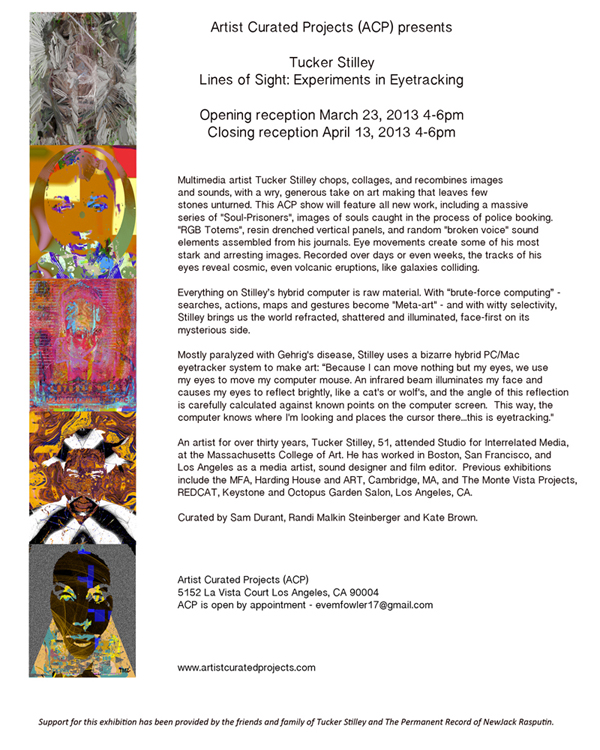
Event Details
Exhibition Walkthrough
July 13th, 2012Join Fowler Museum Director, Marla Berns and Photographer, Randi Malkin Steinberger for an informal walkthrough of the exhibition, Order and Disorder: Alighiero Boetti by Afghan Women.
Event Details
Exhibition Walk through
July 13th, 2012Join Fowler Museum Director, Marla Berns and Photographer, Randi Malkin Steinberger for an informal walkthrough of the exhibition, Order and Disorder: Alighiero Boetti by Afghan Women.
Culture Fix
April 23rd, 2012Walk through Order and Disorder: Alighiero Boetti by Afghan Women with photographer Randi Malkin Steinberger. She will discuss her photographs featured in the exhibition, revealing her experiences and observations during her trip to Peshawar, Pakistan, where she photographed Afghan women embroidering Boetti works.
Event Details
Culture Fix: Randi Malkin Steinberger on Photographing Afghan Women Embroidering Boetti Works
March 28th, 2012Photographer Randi Malkin Steinberger discusses her photographs featured in Order and Disorder: Alighiero Boetti by Afghan Women, revealing her experiences and observations during her trip to Peshawar, Pakistan, where she photographed Afghan women embroidering Boetti works.
Book Signing and ARTTABLE Conversation at the MCA in Chicago
March 27th, 2012A conversation with Randi Malkin Steinberger, photographer and author of “Boetti by Afghan People: Peshawar, Pakistan, 1990,” and Mary Jane Jacob, Professor and Executive Director of Exhibitions and Exhibition Studies, School of the Art Institute of Chicago. Book signing and refreshments to follow.
Conversation: 5-6pm – BY INVITATION + OPEN TO ART TABLE MEMBERS
Book signing, Refreshments, and MCA galleries: 6-7pm – OPEN TO ALL
Event Details
Boetti Retrospective in New York
February 1st, 2012This retrospective, organized in collaboration with the Museo Reina Sofía in Madrid and the Tate Modern in London, will be the largest presentation outside of Italy of works by Italian artist Alighiero Boetti (1940–1994) to date. Working in his hometown of Turin in the early 1960s amidst a close community of artists that included Luciano Fabro, Mario Merz, Giulio Paolini, and Michelangelo Pistoletto, among others, Boetti established himself as one of the leading artists of the Arte Povera movement.
Organized chronologically, the exhibition will span Boetti’s entire career beginning with his sculptural works, or objects as he preferred to call them, comprised of everyday materials including wood, cardboard, and aluminum. Brought together (many for the first time since Boetti’s seminal exhibition at Galleria Christian Stein in Turin in 1967) and installed in a dense configuration inspired by the original clustered presentation, these early works convey the material experiments of the period as well as notions of measurement and chance that Boetti would play with and revise throughout his career. While Boetti is often chiefly affiliated with the Arte Povera moment, Alighiero Boetti: Game Plan will consider Boetti beyond these brief years. In 1969 Boetti began exploring notions of duality and multiplicity, order and disorder, travel and geography, and he initiated postal and map works imagining distant places. For the work Viaggi Postali, begun the summer of 1969, Boetti sent envelopes to friends, family, and fellow artists but used imaginary addresses, forwarding each returned envelope to yet another non-existent place. Boetti thus created imaginary journeys for the people he admired. In other conceptual, mail art-related works made throughout the 1970s, Boetti would use different stamps and arrange them in permutations on the envelopes to compose his art, and send postcards picturing a monument in his hometown from places around the world. The exhibition brings together these and other works related to travel, geography, and mapping, many of which relate to his extensive travels to Afghanistan, where he operated the One Hotel (archival material from which will be on view) from 1971 until the Soviet invasion in 1979. During this period, Boetti began working with local artisans to produce embroideries such as the Mappas (maps), Arazzi (word squares), and Tuttos (literally, “Everything”), important examples of which will be included in the galleries and the Marron Atrium.
An important aspect of Boetti’s oeuvre is drawing, which runs as a constant throughout his work. A monumental Biro (ball point pen) drawing from 1973, spelling out the title “Mettere a mondo il mondo (Bringing the world into the world)” points to some of Boetti’s ideas about art making that were fundamental to his practice: that the artist, rather than inventing, simply brings what already exists in the world into the work; and that everything in the world is potentially useful for the artist. This exhibition will celebrate the material diversity, conceptual complexity, and visual beauty of Boetti’s work, bringing together his ideas about order and disorder, non-invention, and the way in which the work addresses the whole world, travel, and time, proving him to be one of the most important and influential international artists of his generation.
Boetti Retrospective in New York
February 1st, 2012This retrospective, organized in collaboration with the Museo Reina Sofía in Madrid and the Tate Modern in London, will be the largest presentation outside of Italy of works by Italian artist Alighiero Boetti (1940–1994) to date. Working in his hometown of Turin in the early 1960s amidst a close community of artists that included Luciano Fabro, Mario Merz, Giulio Paolini, and Michelangelo Pistoletto, among others, Boetti established himself as one of the leading artists of the Arte Povera movement.
Organized chronologically, the exhibition will span Boetti’s entire career beginning with his sculptural works, or objects as he preferred to call them, comprised of everyday materials including wood, cardboard, and aluminum. Brought together (many for the first time since Boetti’s seminal exhibition at Galleria Christian Stein in Turin in 1967) and installed in a dense configuration inspired by the original clustered presentation, these early works convey the material experiments of the period as well as notions of measurement and chance that Boetti would play with and revise throughout his career. While Boetti is often chiefly affiliated with the Arte Povera moment, Alighiero Boetti: Game Plan will consider Boetti beyond these brief years. In 1969 Boetti began exploring notions of duality and multiplicity, order and disorder, travel and geography, and he initiated postal and map works imagining distant places. For the work Viaggi Postali, begun the summer of 1969, Boetti sent envelopes to friends, family, and fellow artists but used imaginary addresses, forwarding each returned envelope to yet another non-existent place. Boetti thus created imaginary journeys for the people he admired. In other conceptual, mail art-related works made throughout the 1970s, Boetti would use different stamps and arrange them in permutations on the envelopes to compose his art, and send postcards picturing a monument in his hometown from places around the world. The exhibition brings together these and other works related to travel, geography, and mapping, many of which relate to his extensive travels to Afghanistan, where he operated the One Hotel (archival material from which will be on view) from 1971 until the Soviet invasion in 1979. During this period, Boetti began working with local artisans to produce embroideries such as the Mappas (maps), Arazzi (word squares), and Tuttos (literally, “Everything”), important examples of which will be included in the galleries and the Marron Atrium.
An important aspect of Boetti’s oeuvre is drawing, which runs as a constant throughout his work. A monumental Biro (ball point pen) drawing from 1973, spelling out the title “Mettere a mondo il mondo (Bringing the world into the world)” points to some of Boetti’s ideas about art making that were fundamental to his practice: that the artist, rather than inventing, simply brings what already exists in the world into the work; and that everything in the world is potentially useful for the artist. This exhibition will celebrate the material diversity, conceptual complexity, and visual beauty of Boetti’s work, bringing together his ideas about order and disorder, non-invention, and the way in which the work addresses the whole world, travel, and time, proving him to be one of the most important and influential international artists of his generation.
Event Details
Boetti Retrospective in London
February 1st, 2012Alighiero E Boetti (1940–1994) was one of the most important and influential Italian artists of the twentieth century. He was a key member of the Arte Povera group of young Italian artists in the late 1960s which was working in radically new ways using simple materials. This will be the first solo show by an Arte Povera artist at Tate Modern. Boetti used industrial materials associated with Turin’s booming economy and later made works using postage stamps, biro pens, and magazine covers. His work engaged with the changing geopolitical situation of his time, much of it made on his travels to places such as Ethiopia and Guatemala and Afghanistan. Between 1971 and 1979 he set up a hotel in Kabul as an art project and created large colourful embroideries, the most famous of these were the Mappa, world maps in which each country features the design of its national flag. Highlights include works never seen in the UK such as the iconic Self-Portrait 1993, a life-size bronze cast of the artist hosing his head with a jet of water. This exhibition will travel to the Museum of Modern Art in New York in July 2012.
Event Details
Open Book – Accanto al Pantheon: Randi Malkin Steinberger’s Snapshots of Alighiero Boetti’s Studio
December 8th, 2011Randi Malkin Steinberger met Alighiero Boetti in the mid-eighties. She spent a six-month period photographing the artist and his studio. In 1989, together they produced Accanto al Pantheon, a limited edition book consisting of a selection of these images. The book is divided into eight chapters, each containing a title given by Boetti and eight photographs. In 1990 Boetti asked Mariuccia Casadio, Laura Cherubini, Luigi Meneghelli, Marco Meneguzzo, Francesca Alfano Miglietti, Giovan Battista Salerno, Giorgio Verzotti, and Angela Vettese to write a text for a specifically chosen chapter. This version of Accanto al Pantheon was published by Prearo Editore in Milan in 1991. Open Book – Accanto al Pantheon features the photos from the book and excerpts from the texts.